| Home | Job | Pinball | Photo Album | Automotive | Press/Awards | Contact |


Satellite Servicing Capabilities Office
The Zero Gravity flight for the flexible fuel hose experimentIntro and background for this project is on this page.
Arrival at the Airfield
We arrived at Building
990 at the Ellington
Air
Force Base,
which is located right next to NASA Johnson Space Center on
May 30,
2013. This is where we will do our final assembly and
from
where
the plane departs for the parabolic flights over the Gulf.
View of the hangar with the NASA C-9 research aircraft. This plane also does parabolic flights, but we will not be taking this one. We were told that unfortunately, this plane would be put into storage.

The next day (5/31/13), the rest of the participants arrived, and shown here was the morning all-hands meeting to kick off our adventure.

Two of our mentors for the week. Frank Prochaska (left), who runs the program for the education office, and Dominic Del Rosso, who runs the entire facility. Not shown is Paul de Leon, who mentored the Flight Opportunities Group.

They are very strict on tool and parts control. All tools must be signed out and everything is grounded if any are missing. As you can see, all tool boxes are 'shadow boxed'.

We performed our unpacking and final assembly in the hangar. What a great backdrop.
Since we arrived one day before the rest of the other projects, we were able to do our final assembly in a relatively quiet environment.

One of the most important pieces of hardware is this 3D motion tracker from OptiTrak corporation. It will be used to track the motion of the flexible hose.
After
many months of preparation, it felt really great to be in
Houston, and
in Hangar 990 at Ellington Field. We found out there
that we
would be taking part in a special edition of the zero G
flight.
NASA has always had separate projects to fly students
and
professionals doing research. We found out that this
campaign would be
the first to combine the two projects into one flight.
The
students were known as "Education
Flight Program", while we career guys were known as "Flight
Opportunities Projects (FOP)".
Although I could not compare otherwise, I really
enjoyed the
interaction with the students, and was grateful for being on
this
campaign. I would soon find out that this week would
be one
of
the best on a professional and personal level. We had
arrived
among fellow flyers and researchers, and every day, the
atmosphere in
the hangar was electric.

Half of the plane will be in use by the education office projects. Here we are
explaining our experiments to member of the team from Oklahoma State University.
It was really great to see the experiments from the students, and to share their excitement in the hangar. Image from Twitter.

Since we were near JSC, we decided to look around, and here we are at the site where astronauts train in the water to simulate the weightlessness of space. This is the Sonny Carter Neutral Bouyance Laboratory.

In the huge Saturn V display near the entrance of Johnson.
Interview by Rosalie Klein of the Morning News.
Archived here and here.
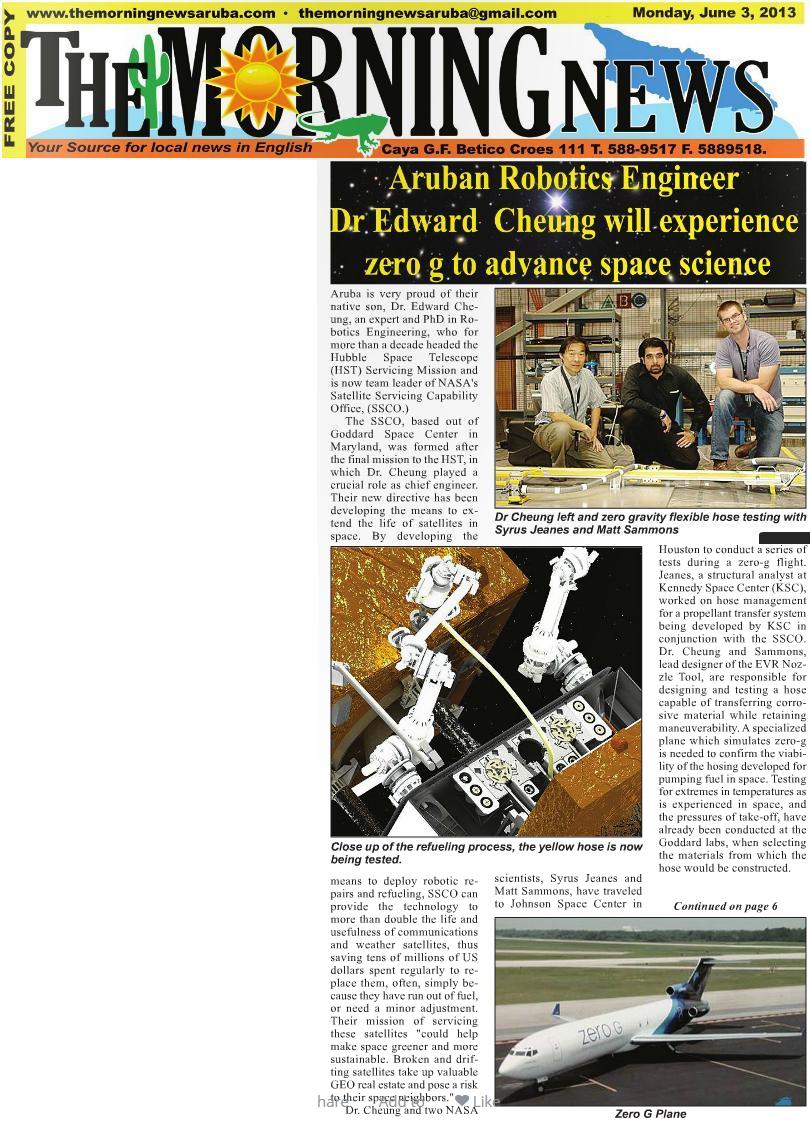
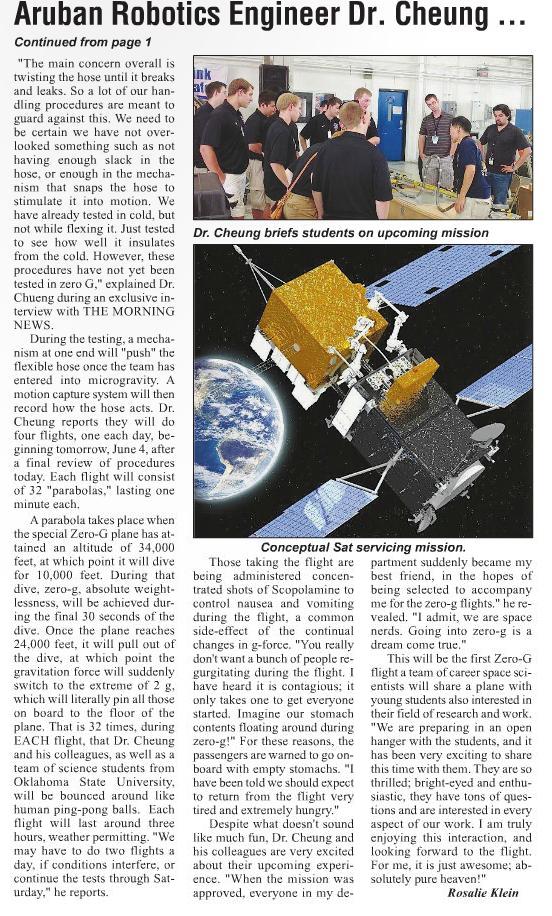
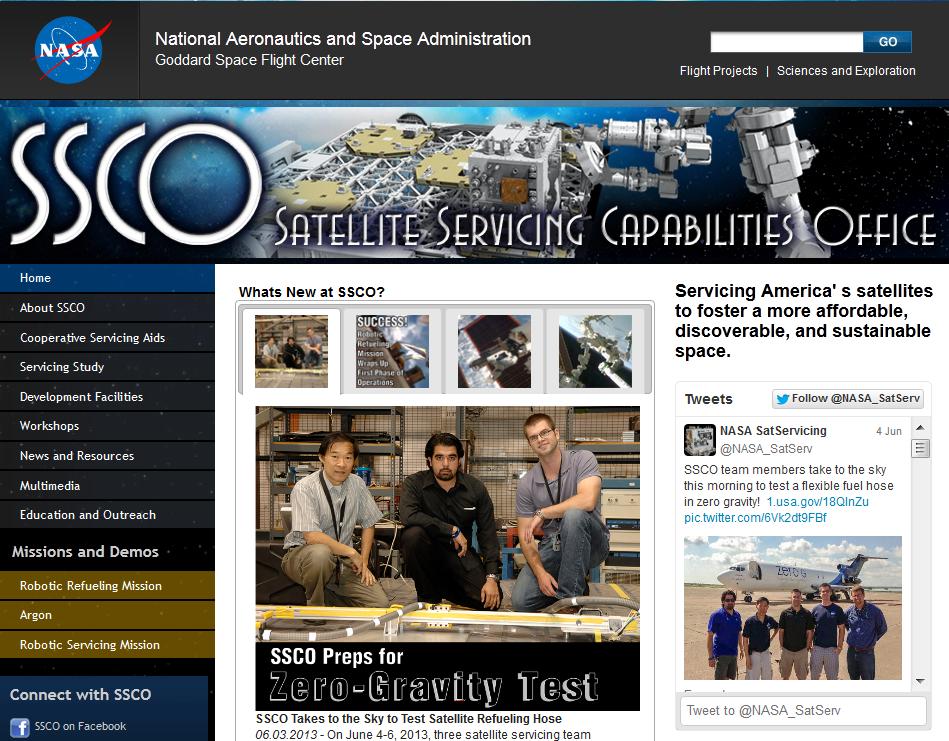
We are on the front page of the SSCO web page.
Article on 24ora.com.
Loading Day
On Monday 6/3, we had our final Test Readiness Reviews, and afterwards received approval to proceed to loading the plane with our hardware. We also receive our flight suits on that day.

Morning breaks on flight week (6/3), and it was a beautiful day. We arrived at the hangar and saw that our plane had arrived. She looked really beautiful.

This is the team I headed up for the flex hose investigation, including the spare flyers.
The new ones are Mike Oetken (middle) and Erik Tormoen (right).

Flyers for a serious mission.

Every day, we have mission briefings at 7:45am sharp for the team leads in the mission briefing room in nearby building 993.

We receive our flight suits on Monday 6/3. A few months before
I bought the flag of Aruba in a patch form.

At the end of Monday (6/3) we completed the loading of our hardware onto the plane, and are located all the way in the front. You can see the OptiTrack sensor on the front right, and the computer that runs all the hardware in the bottom right. We are excited and
happy to get to this point.
On Monday 6/3, we had our final Test Readiness Reviews, and afterwards received approval to proceed to loading the plane with our hardware. We also receive our flight suits on that day.
Morning breaks on flight week (6/3), and it was a beautiful day. We arrived at the hangar and saw that our plane had arrived. She looked really beautiful.
This is the team I headed up for the flex hose investigation, including the spare flyers.
The new ones are Mike Oetken (middle) and Erik Tormoen (right).
Flyers for a serious mission.
Every day, we have mission briefings at 7:45am sharp for the team leads in the mission briefing room in nearby building 993.
We receive our flight suits on Monday 6/3. A few months before
I bought the flag of Aruba in a patch form.
At the end of Monday (6/3) we completed the loading of our hardware onto the plane, and are located all the way in the front. You can see the OptiTrack sensor on the front right, and the computer that runs all the hardware in the bottom right. We are excited and
happy to get to this point.
In
the above image, you can see the laptop that was used to
run the
electronic gear. One interesting note is that we
had to use a
computer with a solid-state drive (SSD). This is
because
modern
laptop have a sensor
that
safes the disk drive
in the event that it detects it has been dropped.
On a
previous
flight, another team found their laptop stopped working
because this
sensor detected the transition into zero gravity, and
their computer
shut down.
Flights in Zero Gravity
We had four flight days from 6/4 to 6/7. The daily routine was approximately as follows: we would arrive at around 7am at the hangar (Building 990), and I would attend the team-leads meeting at 7:45am in the mission briefing room (Building 993). Afterwards, I would brief my team mates back at the hangar, and then the flyers for that day would go to the medical briefing at 8:15am back in 993. This is where the flight doctor gave us instructions on how to avoid motion sickness, and where he would administer an optional shot of Scopolamine. We would then return to the hangar to pick up our gear, and line up next to the tarmac in a single file. As we board, we walk in a single file to allow the photographers to get a good shot of each of us. Although most of the cabin is open, there are rows of seats in the back of the aircraft, and that is where we are seated. As we walk into the plane, our identity is checked, and we are able to pick up some hard candies for snacking (more on that below). We would usually take off around 9:50 am, and we are allowed to get up from our seats and walk to our experimental setups as soon as we hit 10,000 feet. This is a strange feeling as the plane is still climbing, and you are basically walking uphill on the padded floor of the plane. We would fly out to Matagorda Bay, and then turn South over the Gulf of Mexico. While flying South, we would perform 16 parabolas, take a few minutes to turn around, and fly another 16 on the way back. On each day we would usually do 30 parabolas in zero gravity, and then one in Lunar, and one in Martian gravity (so 32 total per day). We would then land in the afternoon, and rest and prep for the next day.
We had four flight days from 6/4 to 6/7. The daily routine was approximately as follows: we would arrive at around 7am at the hangar (Building 990), and I would attend the team-leads meeting at 7:45am in the mission briefing room (Building 993). Afterwards, I would brief my team mates back at the hangar, and then the flyers for that day would go to the medical briefing at 8:15am back in 993. This is where the flight doctor gave us instructions on how to avoid motion sickness, and where he would administer an optional shot of Scopolamine. We would then return to the hangar to pick up our gear, and line up next to the tarmac in a single file. As we board, we walk in a single file to allow the photographers to get a good shot of each of us. Although most of the cabin is open, there are rows of seats in the back of the aircraft, and that is where we are seated. As we walk into the plane, our identity is checked, and we are able to pick up some hard candies for snacking (more on that below). We would usually take off around 9:50 am, and we are allowed to get up from our seats and walk to our experimental setups as soon as we hit 10,000 feet. This is a strange feeling as the plane is still climbing, and you are basically walking uphill on the padded floor of the plane. We would fly out to Matagorda Bay, and then turn South over the Gulf of Mexico. While flying South, we would perform 16 parabolas, take a few minutes to turn around, and fly another 16 on the way back. On each day we would usually do 30 parabolas in zero gravity, and then one in Lunar, and one in Martian gravity (so 32 total per day). We would then land in the afternoon, and rest and prep for the next day.

The flight path for our zero gravity flights. We take off from Ellington (top of the image). Once we get over Matagorda Bay, we turn South. At that point we start the parabolic trajectories, doing 16 of them on the way out. There is then a turn around (bottom of image), and we do another 16 on the way back.

The parabolic curve we flew.
Medical Assistance with Motion
Sickness
The medical doctor gave us the option of taking Scopalamine to counteract motion sickness. This was highly recommended, and could be taken orally or by injection. The former would take longer to take effect, and would take longer to get out of your system, so as a result. I chose the second option every day. The flight doctor also flew with us, so he could keep an eye on everyone.
On the first flight day, I took a full dosage for my weight of 0.2mg, and found out after 15 minutes the extremely debilitating effects of the drug. My whole world was spinning and I was walking unsteady, and I wondered how I was going to do on the flight. On subsequent days, I would cut my dosage to the minimum of 0.1mg, and did much, much better. Another aspect (as we were warned) is that the boarding of the aircraft gives you such an adrenaline rush that it partially counteracts the debilitating effects, which also helped.
Another effect of the Scopolamine is that it gives you a very dry mouth, so I used hard candy to counteract this side effect. In the end, the downside of the drug was worth it as I never got nausea during the flights, and racked up 120 parabolas in zero gravity (a total of over 40 minutes in zero gravity), and several parabolas in Lunar and Martian gravity without getting ill. However, after a few days of taking the Scopolamine (I flew every day), I could sometimes feel the floor moving when I walked up and down stairs, or when I dipped my head down and up. I did not mind it actually, as it was a constant reminder that it was flight week and the associated excitement.
We are also briefed that the most critical part (as far as motion sickness is concerned) is the short 2G period between each zero G portion. A very important measure is to keep your neck straight during this time, so that means do not tilt your head back or forward during this time. You are allowed to move your shoulders and neck together to look around, but it is very important not to tilt your head during the high G period.
The medical doctor gave us the option of taking Scopalamine to counteract motion sickness. This was highly recommended, and could be taken orally or by injection. The former would take longer to take effect, and would take longer to get out of your system, so as a result. I chose the second option every day. The flight doctor also flew with us, so he could keep an eye on everyone.
On the first flight day, I took a full dosage for my weight of 0.2mg, and found out after 15 minutes the extremely debilitating effects of the drug. My whole world was spinning and I was walking unsteady, and I wondered how I was going to do on the flight. On subsequent days, I would cut my dosage to the minimum of 0.1mg, and did much, much better. Another aspect (as we were warned) is that the boarding of the aircraft gives you such an adrenaline rush that it partially counteracts the debilitating effects, which also helped.
Another effect of the Scopolamine is that it gives you a very dry mouth, so I used hard candy to counteract this side effect. In the end, the downside of the drug was worth it as I never got nausea during the flights, and racked up 120 parabolas in zero gravity (a total of over 40 minutes in zero gravity), and several parabolas in Lunar and Martian gravity without getting ill. However, after a few days of taking the Scopolamine (I flew every day), I could sometimes feel the floor moving when I walked up and down stairs, or when I dipped my head down and up. I did not mind it actually, as it was a constant reminder that it was flight week and the associated excitement.
We are also briefed that the most critical part (as far as motion sickness is concerned) is the short 2G period between each zero G portion. A very important measure is to keep your neck straight during this time, so that means do not tilt your head back or forward during this time. You are allowed to move your shoulders and neck together to look around, but it is very important not to tilt your head during the high G period.

First flight day of our campaign. It felt so strange to be first at around 2 Gs, and then into Zero G. We flew for 30 parabolas lasting a few minutes at zero G, and one at Martian, and one at Lunar gravity for the other experiments.
The Sensation of Zero Gravity
The sensation of zero gravity is produced by the lack of feeling any forces from your surroundings. To do this on Earth, you need to put your body into free fall so that everything arounds you experiences the same downward accelleration due to gravity. This is the same thing that occurs to astronauts in space except the constant falling motion produces a circular orbital motion around the Earth. This article on Wikipedia has more info. On the plane this occurs by essentially free-falling through the atmosphere to achieve zero gravity, but it also means that you need to stop this motion and regain altitude by pitching up steeply, which causes the passengers to briefly experience 2Gs. This constant up and down roller coaster motion can be disorienting, so this is done using a plane that has no windows.
The whole experience of free fall is extremely foreign to what the human body is used to. It produced several unexpected and undesirable reactions for me. At the start of each parabola, the pilot climbs up steeply to gain altitude. This causes the plane to greatly lose airspeed (it is in this period that the flyers experience the 2Gs). When flying in an airliner, you are used to the low roar that the outside air produces as it rushes past the fuselage, and you do not realize the source of this sound. After a few parabolas I quickly noticed that when the pilot pitched up, this roar would gradually disappear (leading me to realize that we were losing air speed), and it would actually get rather quiet inside the plane. So much so that the hissing sound of the air in the air-conditioning airvents would start to dominate. This audible transition can be heard in all the video recordings that we shot, and it became an audible warning for me for what was to follow. Once the pilot reaches the top of the parabola, he 'pushes over', and starts the free fall dive. This is just like the motion that a roller coaster does at the top of a big descent. And, just like when I ride coasters, this phase initially produced the same sinking feeling in my stomach. This was the first of the unexpected reactions, and it was quite scary and disorienting in the first few parabolas of the first day.
The downward arc causes your body to float up relative to the plane, and of course, once you are off the floor and away from the walls, there is no way to control the motion of your body. We were warned during the pre-flight briefings to not float over someone else's hardware as we can cause damage when the zero gravity portion ends. Also if the plane experiences a turbulent pocket of air, the plane will be bumped around, and that makes you look like you are moving around inside the plane. All these things occurred on my first flight, and in my quest to prevent from floating over someone else's hardware, lead me to some hilarious bouncing and flailing on my part. You can see a video of that below. This video was played at a meeting with my coworkers during flight week, and they all had a great laugh at that.
The sensation of zero gravity is produced by the lack of feeling any forces from your surroundings. To do this on Earth, you need to put your body into free fall so that everything arounds you experiences the same downward accelleration due to gravity. This is the same thing that occurs to astronauts in space except the constant falling motion produces a circular orbital motion around the Earth. This article on Wikipedia has more info. On the plane this occurs by essentially free-falling through the atmosphere to achieve zero gravity, but it also means that you need to stop this motion and regain altitude by pitching up steeply, which causes the passengers to briefly experience 2Gs. This constant up and down roller coaster motion can be disorienting, so this is done using a plane that has no windows.
The whole experience of free fall is extremely foreign to what the human body is used to. It produced several unexpected and undesirable reactions for me. At the start of each parabola, the pilot climbs up steeply to gain altitude. This causes the plane to greatly lose airspeed (it is in this period that the flyers experience the 2Gs). When flying in an airliner, you are used to the low roar that the outside air produces as it rushes past the fuselage, and you do not realize the source of this sound. After a few parabolas I quickly noticed that when the pilot pitched up, this roar would gradually disappear (leading me to realize that we were losing air speed), and it would actually get rather quiet inside the plane. So much so that the hissing sound of the air in the air-conditioning airvents would start to dominate. This audible transition can be heard in all the video recordings that we shot, and it became an audible warning for me for what was to follow. Once the pilot reaches the top of the parabola, he 'pushes over', and starts the free fall dive. This is just like the motion that a roller coaster does at the top of a big descent. And, just like when I ride coasters, this phase initially produced the same sinking feeling in my stomach. This was the first of the unexpected reactions, and it was quite scary and disorienting in the first few parabolas of the first day.
The downward arc causes your body to float up relative to the plane, and of course, once you are off the floor and away from the walls, there is no way to control the motion of your body. We were warned during the pre-flight briefings to not float over someone else's hardware as we can cause damage when the zero gravity portion ends. Also if the plane experiences a turbulent pocket of air, the plane will be bumped around, and that makes you look like you are moving around inside the plane. All these things occurred on my first flight, and in my quest to prevent from floating over someone else's hardware, lead me to some hilarious bouncing and flailing on my part. You can see a video of that below. This video was played at a meeting with my coworkers during flight week, and they all had a great laugh at that.
Short video of my first flight. I tumble hilariously through the cabin.

The feeling of floating can be quite euphoric. Note the 0.01 g on the display in front.
Another unexpected reaction was that my eyeballs (and vision) would flicker up and down rapidly during the transition from 2G to 0G during the initial two parabollas. This condition is known as Nystagmus. My interpretation was that my body was sensing the downward accelleration in the plane (with the sinking feeling in stomach), and it was expecting the walls to move downward rapidly. To track the walls, my eyes were flickering downward and then back when they realized that the walls were not moving. This reaction was confirmed later in 2013 when I rode 'Mission: Space' at the Disney Epcot theme park. In that ride, you are spun inside a motion simulator ride. I could tell my eyes were flickering left-right when the G level was changing. I realized we were being accelerated in an angular motion, and my eyeballs were anticipating things to start spinning, and in order to track, my vision was flicking sideways.
After a few parabolas, the above unpleasant sensations (sinking feeling in stomach, eyes flickering) stopped occurring, and it became a pleasant and gentle feeling to go into zero gravity. In total, I did this 120 times, and became quite comfortable with the transition. Due to the measures above, I was able to prevent any symptoms of motion sickness for the flights. By contrast, the transition into 1G was very easy, and I did not feel any strange symptoms.
On the second day, I moved around more gracefully.
I
have been asked quite often what it felt like to be in zero
gravity.
After I got used to the transitions into zero gravity,
the
feeling was very euphoric. It was similar to swimming
underwater,
and the lack of gravity produces no strange and unusual
feelings in
your inner ear or anywhere else in your body. Of
course,
unlike
in the water, no amount of arm and leg movement will result
in being
able to push yourself through the cabin, so you need to
first hold down
firmly during the transition, and then you are able to push
off and
float. For most of the parabolas, we were of course working
and doing
our flex hose experiments. This did not allow much time for
tumbling around. Fortunately, I had decided to put the
actuation
button for the flex hose mechanism on a hand held pendant,
so I could
be anywhere to fire it. As a result, I was more free
than
others
to float around and enjoy the experience. However, for
the
last
few parabolas of the week, we took time to fly around, and
produced
some of the best pictures of the week.
On the final and fourth day, I could move myself better on my own.
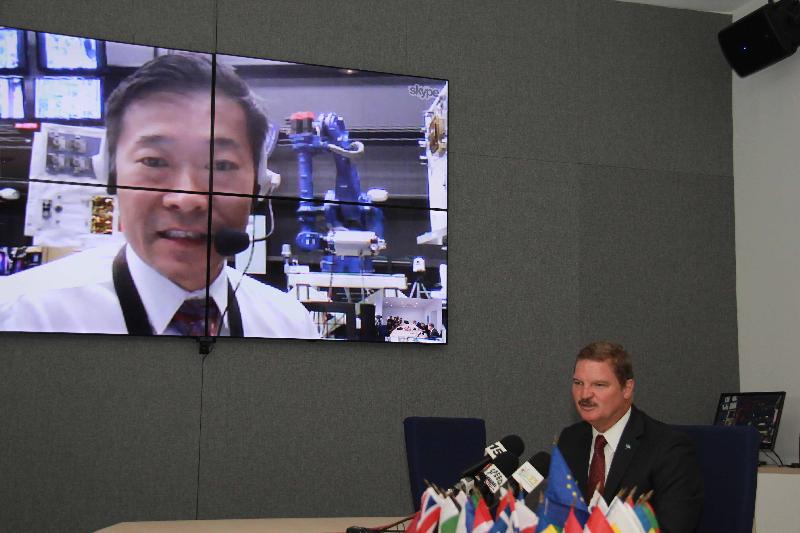
Press conference with Prime Minister Eman at my building.
Article on Morning News.
On 24ora.com.
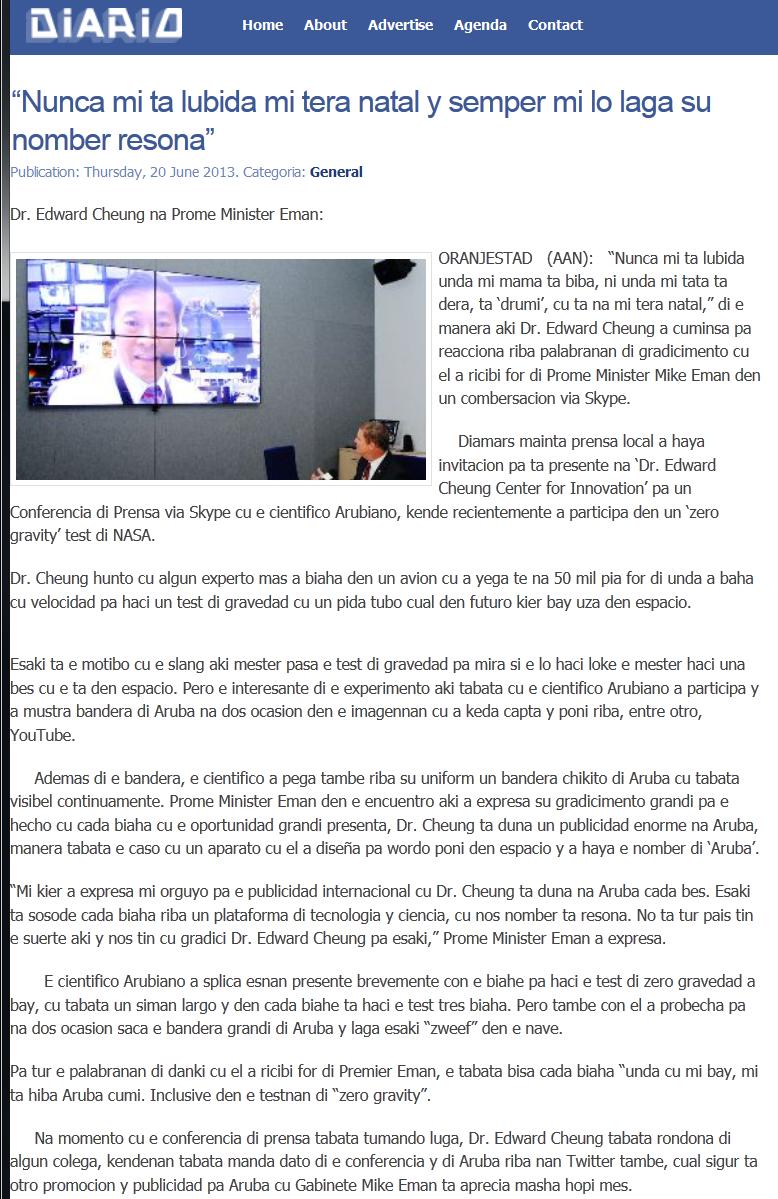
On Diario.com Archived

Even months later, there are weeks that Aruba leads everyone else in
those that engage with SSCO on social media.

This week has been filled with many firsts and many amazing events.
I will never forget it and hope to fly again in the future.
After this project, I continued my Satellite Servicing work
on Phase 2 of the Robotic Refueling Mission.
Article on NASA.GOV about this work.
Links
- Aruba's
Flag in Zero Gravity
- NASA Reduced Gravity Research Program
- Zero G corporation.
- Flight Opportunities' page for our team.
- FY13
report featuring our flights and
results. Archive.
- Flicker page
with high
resolution
pictures of this week.
- Article on the Zero-G plane from Air & Space Magazine.
- Website for the Satellite Servicing Capabilities Office.
- Article
about this work on NASA.GOV (Oct 2023).