| Home | Job | Pinball | Photo Album | Automotive | Press/Awards | Contact |

Satellite Servicing Demonstration
The Hubble Servicing Project goes to workon other Satellites
After so many successful
Hubble servicing missions our project has been tasked with
taking this expertise to studying the servicing other
Satellites in space. In the Fall of 2009, we started
work on demonstration missions for the International Space
Station that evaluate certain important Satellite
Servicing technologies.

The International Space Station
The first of our
demonstration missions illustrates on-orbit refueling of
another spacecraft. In other words, the refill of the
fuel that satellites need to stay in the proper location in
their orbit. This activity is important as many
communications satellites have a limited life due to their
fuel load at launch. If they could be refueled in
space, it would mean a significant extension of their
operating life and savings in operating costs. This
demonstration mission is formally called "Robotic Refueling
Mission", or RRM. My role on this new project is the
Electrical Lead engineer responsible for the electronics in
the tools and the refueling station.
Our hardware will be flown and installed onto an Express Logistics Carrier (ELC). Our experiment is the grey box in the image below.
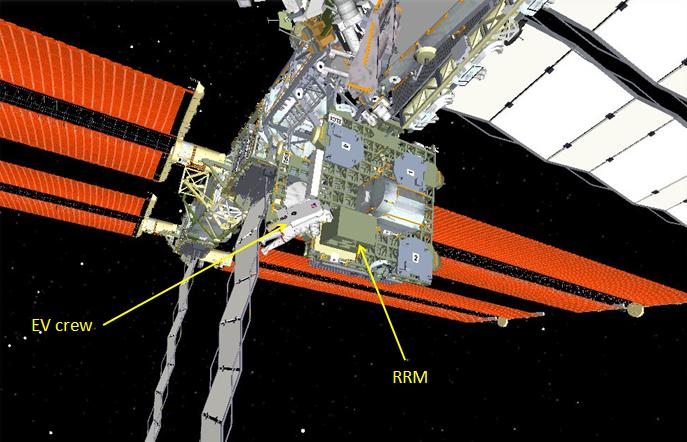
RRM as installed onto an ELC-4 once it is on the International Space Station
The objective of our RRM mission will be to open up a fuel valve cap and pass liquid into it via fuel filler hose. This valve is typical of what satellites use so that we perform the same operations in a faithful manner. This demonstrates our ability to develop tools and procedures to refuel a satellite in space.
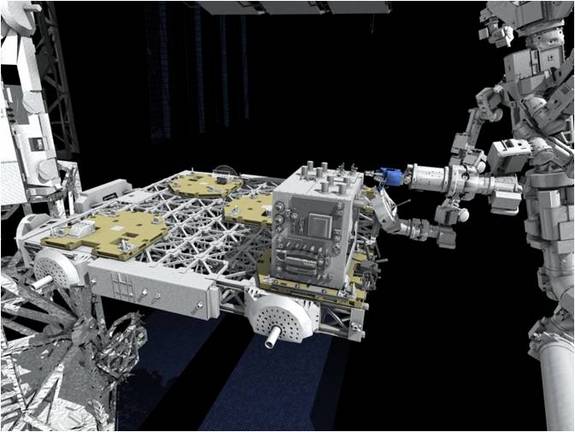
Artist conception of how we will look once on Space Station
on the Express Logistics Carrier (ELC) and working with
the Dextre robot (right).
Since the RRM mission is a demonstration, both halves of the
refueling hardware (satellite to be refueled and the tools
and filler nozzle) is contained on RRM. Essentially,
we will be pumping fluid in a closed loop. RRM will
include four tools, each of these incorporating electronics
and two cameras and lights. In addition, the refueling
station will have pumps and controllers as well as
electrical valves and sensors. My work consists of the
design, construction and test of these electrical systems.
The operations that the robot performs in this video are as follows:

Lab test of the RRM project. The robot holds a refueling tool. The grey box in the previous image is represented by the one covered in gold foil.
Our hardware will be flown and installed onto an Express Logistics Carrier (ELC). Our experiment is the grey box in the image below.
RRM as installed onto an ELC-4 once it is on the International Space Station
The objective of our RRM mission will be to open up a fuel valve cap and pass liquid into it via fuel filler hose. This valve is typical of what satellites use so that we perform the same operations in a faithful manner. This demonstrates our ability to develop tools and procedures to refuel a satellite in space.
Artist conception of how we will look once on Space Station
on the Express Logistics Carrier (ELC) and working with
the Dextre robot (right).
The operations that the robot performs in this video are as follows:
- At 0:39, the Wire Cutter Tool (WCT) is retrieved to cut the safety wire that the personnel at the launch site put on the outer cap.
- 1:10, a second tool is retrieved to remove the outer Tertiary Cap.
- 2:10, the WCT is retrieved a second time to cut the second wire on the Safety Cap.
- 2:31, the Safety Cap Tool is used to remove the inner Safety Cap.
- 3:29, the WCT is used again to cut another wire.
- 3:50, finally the EVR Nozzle Tool (ENT) is used
connect to the fuel valve and the fuel is transferred.
Lab test of the RRM project. The robot holds a refueling tool. The grey box in the previous image is represented by the one covered in gold foil.
The robot we will use during
our refueling demonstration is the Special Purpose
Dextrous Manipulator (SPDM) robot that is already on
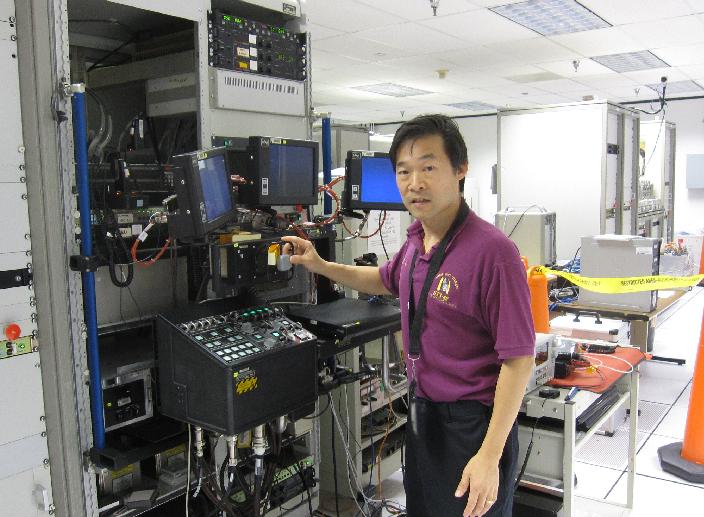
the ISS. Our first hardware to be tested is the camera
interface to the SPDM robot. This was done at the ISIL
facility at the Johnson Space Center in Houston Texas.
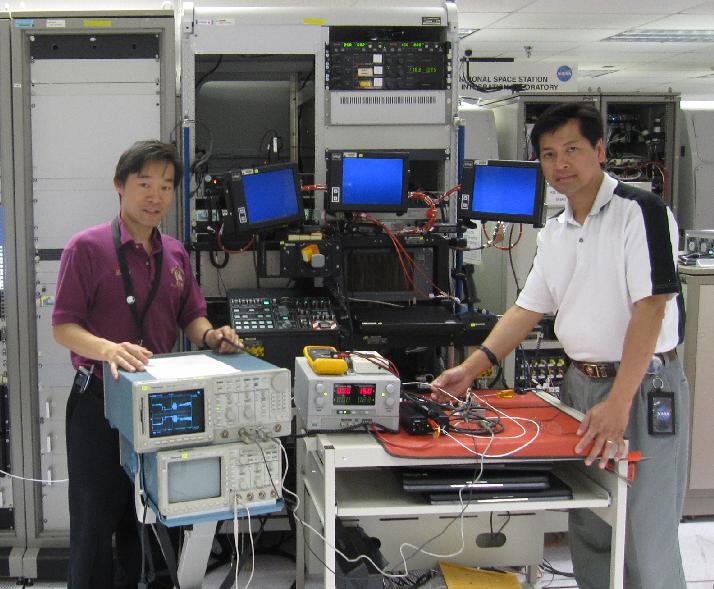
Here with Henry Pham one of the engineers that is part of my team, our test with the Space Station ground simulator (ISIL) at JSC (June 2010). The camera we were using for this test is on the red mat.
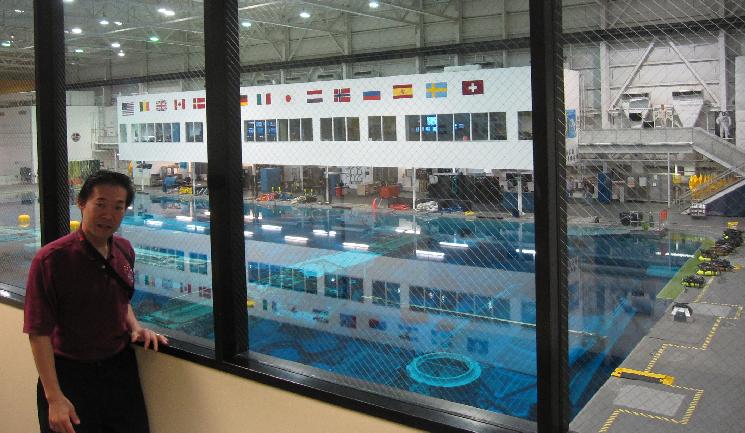
The ISIL is in the same building as the Neutral Bouyancy Lab at the Sonny Carter Facility.
This is where astronauts are trained for space walk missions such as the
Hubble Servicing Missions.

The ACU ready for vibration test. Shown here on the left is Kelvin Garcia (Lead Integration and Test), and Brian Bayne (mechanical design lead for avionics).
In the Fall of 2010, after a
year worth of effort to design the system, we finally have
the finished Avionics Control Unit (ACU). This
circuitry receives commands from the ELC computer and
controls the valves and pumps of the RRM. In the photo
above, we see the ACU on the vibration table. This
test violently shakes the flight hardware to verify its
strength and workmanship against the launch environment on
the Shuttle.
Once the vibration test is complete, we verify that the hardware can survive the vacuum and temperature extremes of space. This is done by putting our flight hardware into a steel thermal-vacuum chamber. All the air is pumped out, and we cycle the temperature hot and cold for many cycles to verify our electronics continue to function under these extreme conditions.

Yanci Viegas and Giovanni Munguia instrumenting the ACU for the thermal vacuum test.
Meanwhile on the tools side, we had also completed the
design of the electronics and we were getting ready to
assemble 8 cameras and their associated hardware in December
of 2010.

The eight flight video cameras (small black right angle units) along with the lights (white cone at top), along with their housings and cables.

Here is one Tool Electronics Box (TEB) assembled with its two cameras and lights. The SPDM robot grabs this box and connects electrically to it.

Four completed tool avionics assemblies. The LED housings are now covered with protective red covers.
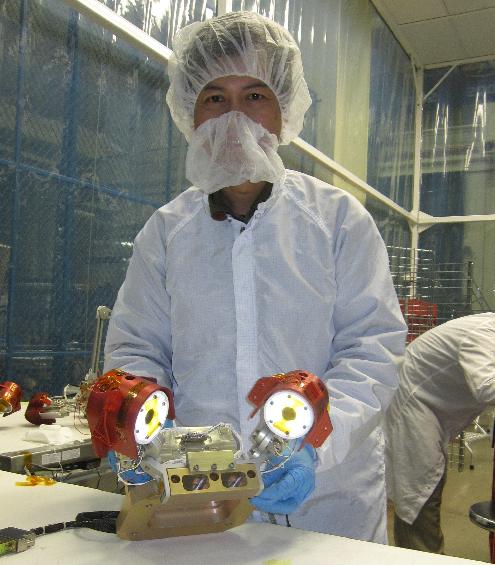
Henry holding up one functioning unit. Note the white LED lights!

After assembly, we placed the four tool avionics unit into a thermal vacuum chamber.
This is a steel chamber that has all the air pumped out during the test,
and the temperature is cycled from cold to hot.
The person in the middle is Raymond Witcher, our Quality
Assurance engineer (photo: Chris Gunn).
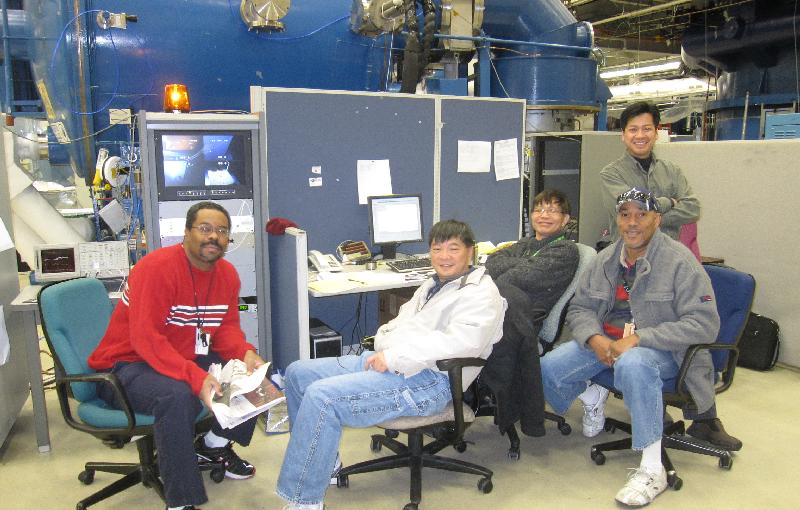
Part of the test team for the TEB Thermal-Vacuum test. You can see the monitor showing
the image of the four cameras under the orange light.
The main RRM hardware is the plate that holds the Fluid
Transfer System (FTS). This has the tanks, pumps,
valves and associated electronics to accomplish the mission
of transferring fluid during the demonstration
mission. This panel is shown below during the build up
process.
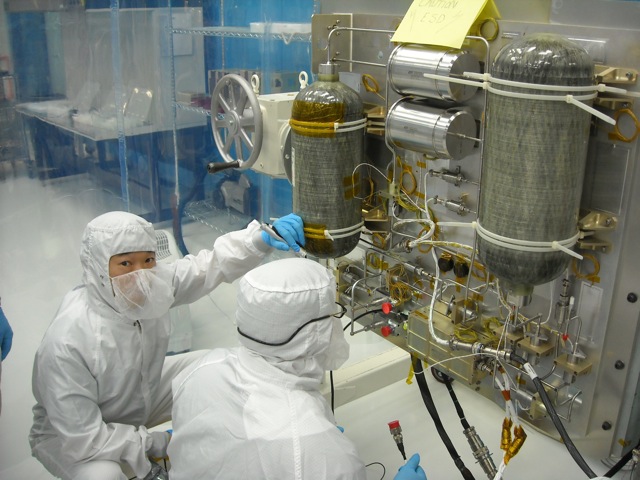
The FTS holds pumps, valves and tanks to accomplish the fluid transfer of the mission.
Once the vibration test is complete, we verify that the hardware can survive the vacuum and temperature extremes of space. This is done by putting our flight hardware into a steel thermal-vacuum chamber. All the air is pumped out, and we cycle the temperature hot and cold for many cycles to verify our electronics continue to function under these extreme conditions.
Yanci Viegas and Giovanni Munguia instrumenting the ACU for the thermal vacuum test.
The eight flight video cameras (small black right angle units) along with the lights (white cone at top), along with their housings and cables.
Here is one Tool Electronics Box (TEB) assembled with its two cameras and lights. The SPDM robot grabs this box and connects electrically to it.
Four completed tool avionics assemblies. The LED housings are now covered with protective red covers.
Henry holding up one functioning unit. Note the white LED lights!
After assembly, we placed the four tool avionics unit into a thermal vacuum chamber.
This is a steel chamber that has all the air pumped out during the test,
and the temperature is cycled from cold to hot.
The person in the middle is Raymond Witcher, our Quality
Assurance engineer (photo: Chris Gunn).
Part of the test team for the TEB Thermal-Vacuum test. You can see the monitor showing
the image of the four cameras under the orange light.
The FTS holds pumps, valves and tanks to accomplish the fluid transfer of the mission.

The ACU, which controls all the hardware is mounted on the opposite side of the panel.
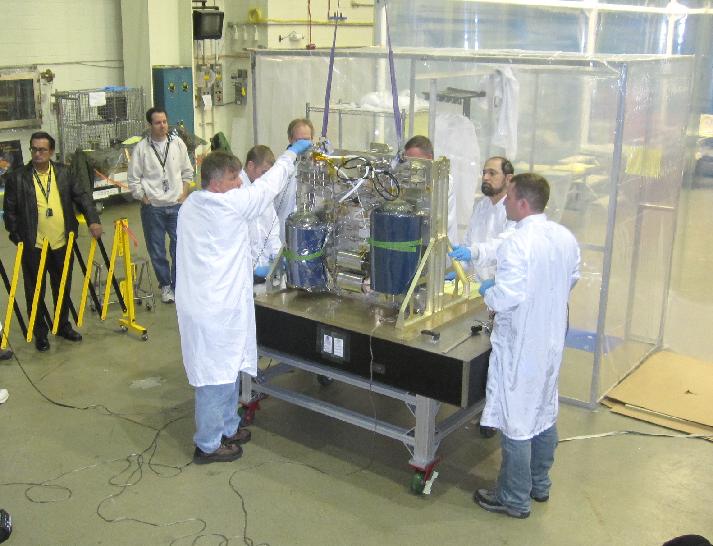
Once the ACU and all the other fluid system components are assembled and tested, the panel is integrated into the RRM structure (December 2010).
Click below for the next page.